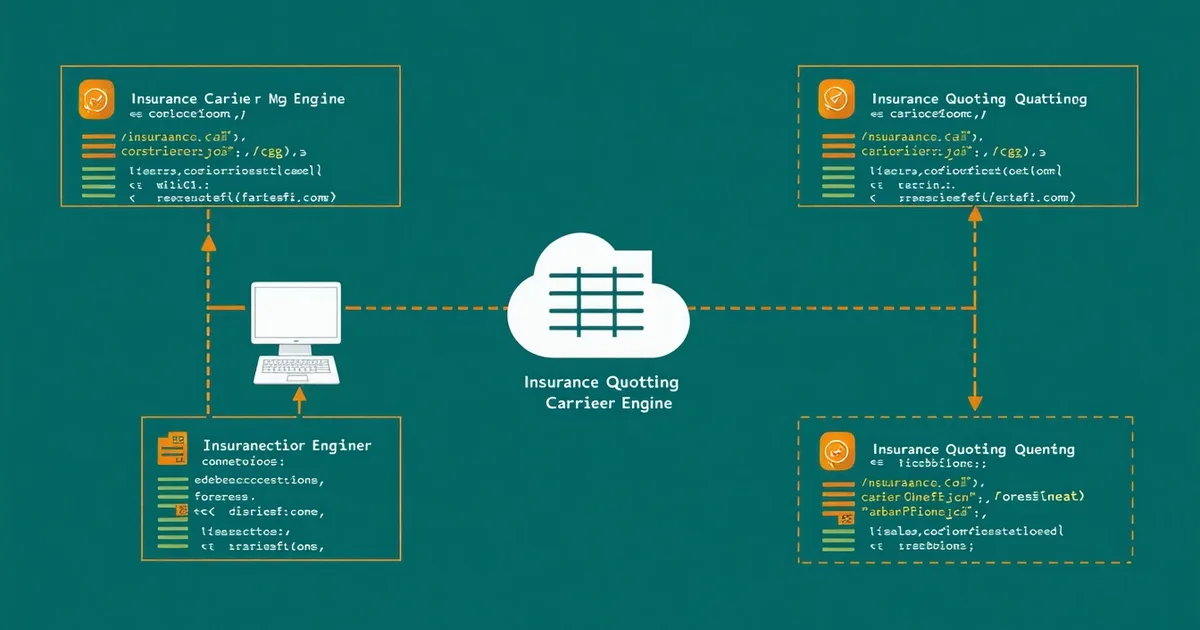
The embedded insurance conversation has been dominated by personal lines examples: checkout-flow travel insurance, device protection at point of electronics sale, renters insurance bundled with an apartment lease application. These are real distribution channels, but they require relatively simple rating logic and standardized policy forms that work at consumer scale. The commercial lines analog — embedding commercial coverage within a B2B workflow — is a structurally different problem, and the carrier API architecture it requires is correspondingly more complex.
This is the conversation that a growing number of MGA and program business partners are having with smaller carriers: can you give us API access to your quoting engine so we can embed a quote-and-bind workflow into our own platform? And for most small commercial-lines carriers, the honest answer is: not right now, but it is a tractable problem if the policy-admin system is built for it.
What "Embedded Insurance" Means for Commercial Lines
In commercial lines, embedded insurance refers to the integration of a coverage quote and bind capability into a third-party platform at the point where the customer's insurance need is most naturally surfaced. A few live examples of the pattern:
- A commercial real estate leasing platform that surfaces a GL and property quote to prospective tenants as part of the lease application workflow. The tenant sees an indication quote and can bind coverage before executing the lease.
- A staffing and workforce platform that offers workers' compensation coverage to businesses hiring temporary workers through the platform. The WC quote is generated based on the payroll classification codes associated with the job type.
- A contractor marketplace that requires GL coverage as a condition of marketplace listing, with coverage available through an embedded quote workflow at the time of contractor registration.
In each case, the coverage is not sold by an agent through a traditional submission process. The trigger is an event in a third-party system — a lease application, a payroll entry, a marketplace registration — and the coverage needs to be quoted and potentially bound in that same session, against that specific risk profile, using the carrier's actual rate logic.
This requires an API. Not a contact form, not a referral link to an agent. An API that accepts structured risk data, runs the carrier's rating algorithm, and returns a premium indication — and that can subsequently accept a bind request and issue a policy or binder.
The API Architecture Problem for Small Carriers
Most small commercial-lines carriers do not have a quote API. Their rating logic lives in a spreadsheet or in a legacy policy-admin system with no external-facing endpoints. Even carriers using modern policy-admin platforms often find that the quoting workflow is only accessible through the platform's own UI, not through an API that a third-party system could call programmatically.
Building a quote API from scratch — exposing the carrier's rating logic as a service that external systems can call — requires the rating engine to be decoupled from the quoting UI. The rate calculation needs to accept a structured input (risk characteristics: class code, state, limit, deductible, exposure basis), run the rating algorithm, and return a structured output (premium components, final indicated premium, coverage summary). That output then needs to be bindable: a second API call that converts the quote to a policy.
The technical challenge here is not writing the API endpoint itself — that is relatively straightforward. The challenge is that most carrier rating engines are not structured to accept arbitrary external input without human review. The underwriting logic that approves or declines a submission — the appetite rules, the individual risk review, the schedule rating adjustments — is embedded in a workflow that assumes a human underwriter is in the loop. An API-accessible quoting engine needs to either automate that review for in-appetite risks (and decline programmatically for out-of-appetite risks) or support a hybrid flow where in-appetite risks are quoted automatically and borderline risks are flagged for underwriter review before the indication is returned.
Program Business and the MGA Distribution Channel
The most immediate application of a carrier quote API for most small commercial-lines carriers is not consumer-facing embedded insurance but program business distribution through MGAs and MGUs. An MGA that manages a book of specialty commercial accounts — a workers' comp MGA focusing on hospitality, or a GL MGA focused on contractors — typically wants to be able to quote and bind coverage for its accounts without navigating the carrier's policy-admin UI directly.
The traditional model for this is a separate agency portal: the carrier builds or buys a web interface that the MGA's staff use to enter submissions and retrieve quotes. This works, but it has the same structural limitation as the underlying policy system: the MGA's staff are doing manual data entry into the carrier's system, and the carrier's system cannot be invoked programmatically by the MGA's own platform.
An API-based model inverts this. The MGA's own submission management platform — wherever their book of accounts lives — sends a structured quote request to the carrier's API. The carrier's rating engine processes the request against the program guidelines, returns an indication, and the MGA's platform presents the quote to the agent or account manager within their own workflow. The bind request, if the account accepts, goes back through the same API channel.
Consider a specialty commercial auto MGA writing owner-operator trucking coverage across Midwestern states. The MGA manages 1,800 accounts and uses a custom CRM system to track submissions, quotes, and renewals. The carrier currently requires the MGA's staff to log into a portal and re-enter account data that already exists in the MGA's CRM. A quote API eliminates that step: the CRM queries the carrier's rating engine directly, retrieves the indication, and logs it against the account record. The MGA's underwriters spend their time on account management and borderline risks, not data entry.
We are not claiming that API-based distribution eliminates the need for underwriter oversight of individual accounts. For commercial lines at any meaningful coverage limit, individual risk review is appropriate and often required. What the API model eliminates is the redundant data flow — the same information entered into two systems — and the friction that drives MGAs to prefer carriers with cleaner integration capabilities.
Rate Filing and the Compliance Constraint
An API-accessible quoting engine is still subject to the same rate and rule filing requirements as a manual quoting process. The carrier must use rates that have been filed with and approved by (or are in use under an advisory organization filing in) each state where the policy will be issued. The API call produces a quote using those filed rates; it does not bypass the filing requirement.
This is worth stating directly because some conversations about carrier API access conflate "API accessibility" with "rate flexibility." Carriers operating on ISO advisory loss costs with state-specific deviations filed with each DOI cannot offer a custom rate outside those filings just because the request comes through an API rather than a manual submission. The rate calculation must be consistent with the filed rate and rule basis regardless of the distribution channel.
What an API does enable is faster delivery of the filed-rate indication and programmatic enforcement of the rate/rule logic. The same schedule rating parameters, the same class code to rate table lookups, the same state-specific modifiers — all are applied consistently, every time, without the variance that comes from manual calculation. For an MGA distributing to multiple appointed carriers, this consistency is a significant value proposition: the MGA knows the indication reflects actual filed rates, not a field underwriter's ad hoc approximation.
Webhook-Based Policy Events for Distribution Partners
Beyond the initial quote-and-bind flow, an API-native policy-admin system can expose policy lifecycle events to distribution partners via webhooks. An MGA that placed commercial property coverage through the carrier API can receive real-time notifications when:
- A mid-term endorsement is processed that changes the covered locations or increases the building value above the MGA's program limit
- A FNOL is submitted against a policy in the MGA's book
- A policy is approaching renewal and the renewal premium indication is available
- A policy is cancelled for non-payment and the MGA needs to contact the account
These webhook events allow the MGA to maintain an accurate picture of the accounts in their book without polling the carrier's system or waiting for periodic bordereaux reports. The MGA's CRM receives the event, updates the account record, and triggers whatever workflow the MGA has configured — an automatic renewal notice, an alert to the account manager, a compliance flag for a policy that has changed outside program guidelines.
COI Issuance as an API-Adjacent Problem
Certificates of insurance (COIs) are a persistent operational burden for commercial lines carriers and their MGA partners. An insured contractor needs a COI naming a project owner as additional insured before they can begin work. The request goes to the agent, who requests it from the carrier, who generates the ACORD 25 and returns it through email. The cycle often takes 24–48 hours and involves multiple touchpoints for what should be a fully automated document generation step.
A policy-admin system with an API endpoint for COI generation allows the agent or the insured to request a COI directly through the API — providing the certificate holder details, the job-specific additional insured information, and the required coverage verification — and receive the ACORD 25 PDF immediately. The COI is generated from the live policy record, so the coverage limits and expiration date are always current. The carrier's forms library populates the additional insured endorsement language automatically.
Irys is built API-first. The quoting engine, policy bind, endorsement processing, and COI generation are all accessible as REST endpoints. Distribution partners — MGAs, program administrators, embedded distribution platforms — can integrate Irys into their own workflows without requiring their staff to log into a separate portal. For commercial carriers building out program business distribution in 2025, this is the technical foundation that makes non-portal distribution channels viable.