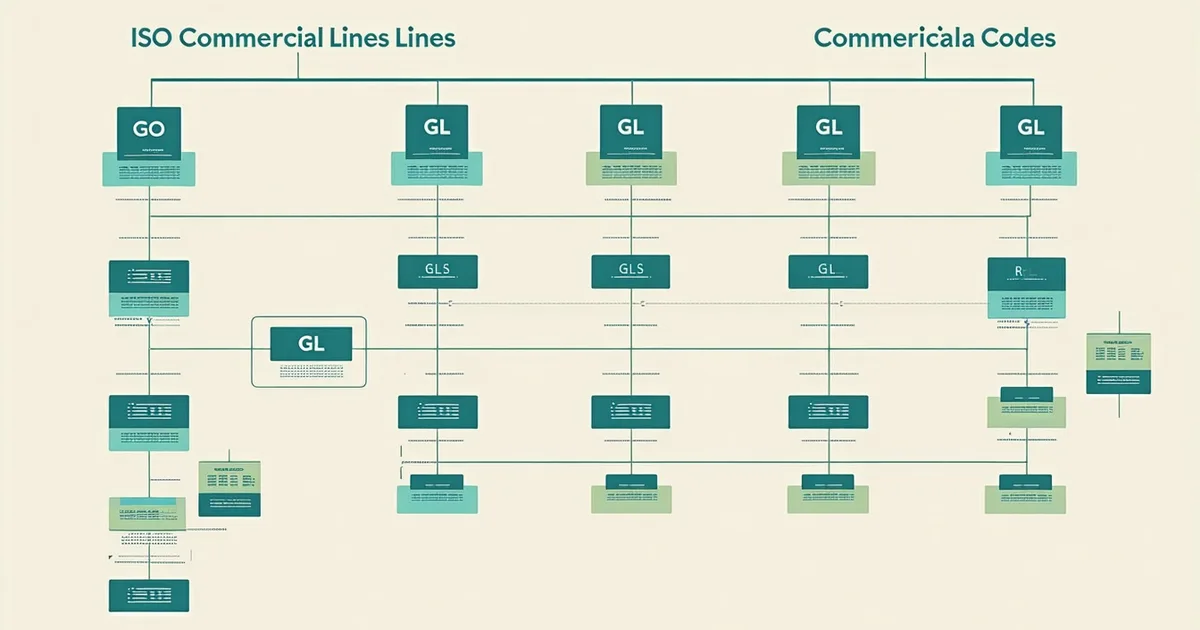
ISO line-of-business codes appear throughout a commercial-lines carrier's operational data: in the rating engine, in the reinsurance treaty scope definition, in the NAIC annual statement, in state DOI rate and rule filings, and in the statistical reporting that feeds ISO's actuarial database. Most carrier operations teams have a working knowledge of the codes they use daily — the GL class codes for the occupancies they commonly write, the property protection class system, the WC class codes for the industries in their book. Fewer have a clear picture of how the full ISO LOB classification hierarchy is structured and why that structure matters for operations beyond basic rating.
This article is a working reference for carrier operations teams — the people who process submissions, catch classification errors before binding, and reconcile policy data for NAIC statutory reporting. It covers the classification hierarchy, the most common misclassification patterns in commercial-lines submissions, and how LOB classification interacts with reinsurance treaty scope and NAIC reporting requirements.
The ISO Classification Hierarchy
ISO organizes commercial insurance into a hierarchy that moves from broad lines of business down to specific coverage forms and class codes. At the top level, the principal commercial lines are:
- Commercial General Liability (CGL) — ISO form series CG, covering bodily injury and property damage arising from the insured's operations, products, and completed operations.
- Commercial Property — ISO form series CP, covering direct physical loss to buildings and business personal property.
- Commercial Auto — ISO form series CA, covering owned, hired, and non-owned autos used in commercial operations.
- Workers' Compensation and Employers' Liability — typically following NCCI class codes in most states (except monopolistic fund states), though ISO provides WC rating guidance in some jurisdictions.
- Inland Marine — ISO form series IM, covering moveable property and property in transit.
- Business Owners Policy (BOP) — ISO form series BP, a packaged GL and property coverage for qualifying smaller commercial risks.
Below these principal lines, ISO organizes coverage by coverage part and by class code. The GL class code is the most granular element that carriers use in daily operations: a 5- or 6-digit code that maps a specific type of business operation to a rate and a set of rating rules in the ISO Commercial Lines Manual.
GL Class Codes: How the Rating Engine Consumes Them
GL class codes in the ISO system are organized into industry groups. The construction trades run roughly from class code 91111 (Carpentry — construction of residential dwellings not exceeding 3 stories) through the 90000s. Mercantile operations occupy a different range. Service operations and professional categories have their own groupings. Each class code carries:
- A premium basis (typically payroll, gross sales, or area — expressed in units per $1,000 or per $100 for area-based classes)
- A base rate for the occurrence and aggregate coverage components
- An eligibility indicator for certain coverage endorsements (products/completed operations, for instance, is separately rated for class codes where products exposure is significant)
- Any state-specific modifiers that the carrier must apply when the risk operates in a filed-rate jurisdiction
When a submission arrives with an ACORD 125 and ACORD 126, the underwriter's first task is to determine the correct GL class code for the operation described. This is not always the same as what the agent has written on the form. Agents sometimes write a class code that underrepresents the exposure (a contractor listed as 91342 "Contractors - subcontracted work" when the operation also includes direct-hire residential work that belongs in a different code), or they use a class code that the carrier does not write (a specialty code that is technically correct but falls outside the carrier's filed appetite).
Consider a workers' compensation MGA in the Southwest writing primarily light manufacturing and distribution accounts. When submissions arrive with ACORD 130 forms, the WC class codes entered by agents frequently reflect the largest payroll category rather than the complete classification breakdown. A warehouse distribution operation might list the entire payroll under a single clerical or warehouse code when the operation includes drivers, forklift operators, and maintenance staff — each with distinct class codes carrying different rates. The difference in WC premium between a correctly classified submission and a under-classified one can be 15–30% of indicated premium, which directly affects both the carrier's profitability and its treaty cession calculations.
BOP Eligibility and the Class Code Gate
The ISO BOP program has an eligibility structure that limits which business types qualify for BOP coverage. ISO's BOP eligibility rules establish maximum building size, occupancy requirements, and class code restrictions — certain hazardous operations are excluded from BOP and must be written on monoline GL and property forms instead. A small retail operation or a professional office generally qualifies. A welding shop or a chemical distributor does not.
BOP eligibility determinations are directly tied to class code. If a submission arrives requesting BOP coverage for an operation that maps to an ISO class code on the BOP ineligible list, the system — or the underwriter — needs to catch that before the policy is issued. Issuing a BOP policy for an ineligible class code creates a coverage form mismatch: the insured has a BOP policy when they should have a commercial lines package, and the difference in coverage terms may matter at claim time.
We are not claiming that every BOP eligibility error results in a coverage dispute — many do not, because the loss types that occur at the ineligible operation may still fall within BOP coverage. The issue is that a carrier that writes ineligible operations on BOP forms may find those policies excluded from treaty reinsurance coverage if the treaty excludes BOP policies for operations exceeding certain hazard thresholds.
LOB Codes in the Reinsurance Treaty Context
Reinsurance treaties define their scope in terms of covered lines of business. A GL quota share treaty, for example, covers policies issued on CGL forms with inception dates within the treaty period — but it may exclude certain class codes (highly hazardous operations, or class codes associated with claim severity patterns that the reinsurer is not comfortable accepting). An XOL property treaty may exclude certain occupancy classes based on fire susceptibility or catastrophe exposure.
The connection between ISO LOB codes in the policy-admin system and the treaty scope definition is where misclassification creates its most consequential downstream problem. If a policy is issued with an incorrect class code — one that falls inside the treaty scope when the correct code would fall outside it, or vice versa — the cession calculation for that policy is wrong. The carrier either cedes a risk the reinsurer did not agree to cover, or fails to cede a risk that the treaty requires to be ceded.
Most small-carrier reinsurance treaties include a provision that allows the reinsurer to audit the bordereau for classification accuracy. When a reinsurer finds policies ceded under treaty scope that belong to excluded class codes, they may retroactively reject those cessions — which means the carrier is holding unprotected retention exposure on losses that have already been incurred.
The practical implication for carrier operations is that LOB classification accuracy is not merely a rating issue. It is a reinsurance compliance issue. Carriers that treat class code review as a quoting accuracy function (is the rate correct?) rather than a compliance function (does this policy belong in the treaty scope it has been assigned to?) are underestimating the downstream exposure of misclassification.
NAIC Annual Statement LOB Reporting
Carriers are required to file NAIC annual statements that include premium, loss, and expense data organized by line of business. The NAIC's Annual Statement Instructions specify the schedule lines — Schedule P, Schedule T, and others — that require LOB breakdowns. The NAIC's LOB definitions are broadly aligned with but not identical to ISO's classification hierarchy; carriers need to map their internal class code data to NAIC schedule lines.
The mapping from ISO class codes to NAIC schedule lines is typically:
- ISO GL class codes → NAIC Schedule P, Part 1 "Other Liability — Occurrence" or "Other Liability — Claims-Made"
- ISO CP property forms → NAIC Schedule P, Part 1 "Allied Lines" or "Fire" depending on peril
- ISO CA commercial auto → NAIC "Commercial Auto Liability" and "Commercial Auto Physical Damage" as separate schedule lines
- NCCI/ISO WC class codes → NAIC "Workers' Compensation"
BOP policies present a specific NAIC reporting complexity: a BOP policy bundles GL and property coverage, but the NAIC annual statement requires those components to be reported separately on their respective schedule lines. A carrier that tracks BOP policies as a single coverage type without breaking out the GL and property premium components will have annual statement reporting errors. The state DOI's market conduct examiners and the carrier's external auditor both look at Schedule P for coherence between written premium, earned premium, and incurred losses by LOB.
Classification Quality Control at Submission Intake
The most effective control point for LOB classification accuracy is at submission intake, not at policy issuance or at the quarterly bordereau reconciliation. A carrier's policy-admin system that validates class codes at submission entry — checking against the carrier's written class code list, the applicable BOP eligibility matrix, and the treaty scope — catches errors when the cost to correct them is low (update the submission before quoting) rather than when the cost is high (endorse an in-force policy and notify the reinsurer).
Useful validation rules at intake include:
- Class code against carrier appetite matrix: is this class code on the written list for this LOB?
- Class code against BOP eligibility: if BOP coverage is requested, is the class code BOP-eligible under ISO guidelines?
- Class code against treaty exclusion list: does this class code fall within the scope of the applicable reinsurance treaty, or is it on the treaty's excluded classes list?
- Class code against premium basis: is the premium basis provided (payroll, gross sales, area) appropriate for the class code's rating basis?
None of these validations replace underwriter judgment about a specific risk. A class code on the treaty exclusion list might still be writable as facultative business. A BOP-ineligible operation might qualify for a commercial lines package at the carrier's appetite. The validation flags the issue for review; the underwriter makes the determination.
Keeping the Class Code Library Current
ISO periodically revises its Commercial Lines Manual, including class code revisions, new class code additions, and retirements of obsolete codes. State DOI filings for rate and rule changes may also affect the applicability of specific class codes in individual jurisdictions. A carrier's class code library — the internal mapping from ISO class codes to rates, eligibility parameters, and treaty scope designations — needs to be updated when those revisions take effect.
In a spreadsheet-based rating environment, class code library updates are manual: someone downloads the ISO revision, updates the rate lookup table, and — critically — ensures that the treaty scope parameters are reviewed for any newly added or reclassified codes. In an integrated policy-admin system, class code updates flow from the rate data import into the rating engine, with automatic checks against the existing treaty scope configuration to flag codes that may require treaty scope review.
Irys maintains the ISO LOB classification hierarchy as structured data within the policy-admin system. Class codes are stored with their premium basis, eligibility parameters, and treaty scope designations — making intake validation, endorsement processing, and bordereau reporting all consistent with the same source of truth. When ISO revisions are applied, the class code library updates propagate through the rating engine, the BOP eligibility checks, and the treaty cession logic in a single operation rather than requiring manual updates to three separate spreadsheets. For carrier operations teams that know class code accuracy is a compliance issue, not just a rating accuracy issue, that consistency matters.