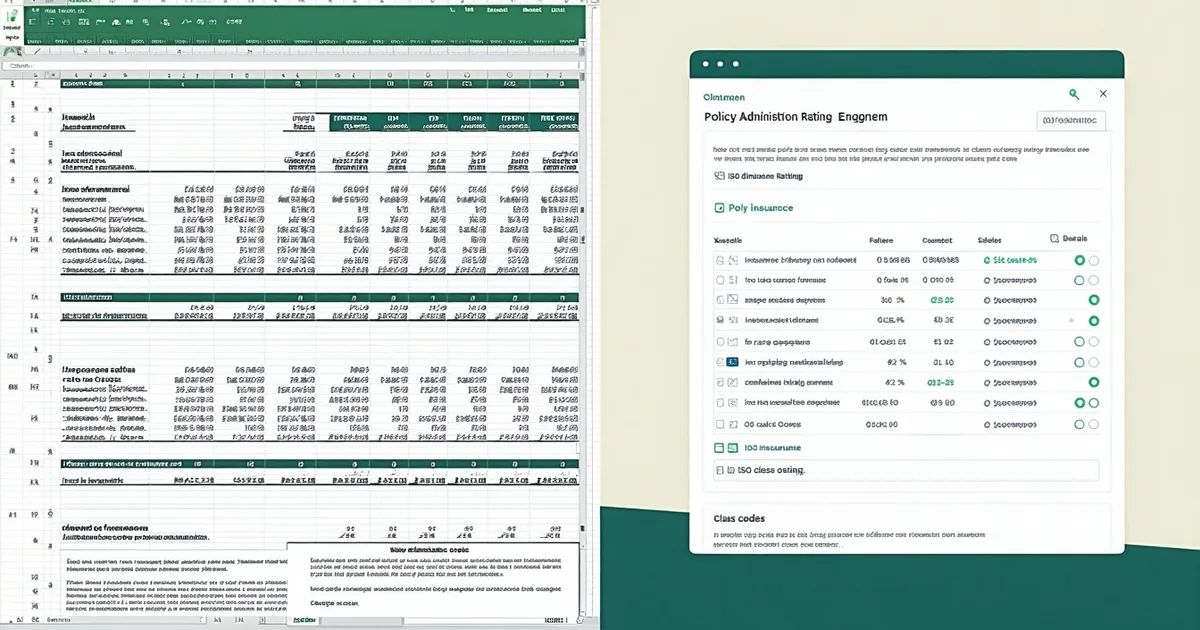
There is a particular kind of institutional knowledge that accumulates inside a carrier's quoting spreadsheet over five or ten years: hidden columns, conditional formatting rules that nobody fully understands, a cell named ISO_ADJ_FACTOR_v3_FINAL_FINAL that an underwriter added in 2019 and nobody has touched since. The spreadsheet works — until the month it doesn't, and by the time you know it has stopped working, you have quoted 300 submissions on a rate table that expired two quarters ago.
This is not a hypothetical. It is the operational pattern at a significant share of commercial-lines carriers writing under $50M in direct written premium. The ISO Commercial Lines Manual publishes rate revisions on a schedule; state DOI filings follow; the policy-admin system — or the spreadsheet standing in for one — needs to reflect those updates before the next renewal cycle. When that update cycle is manual, it breaks under volume.
What "500 Submissions" Actually Means
The threshold where spreadsheet-based rating starts generating material errors is not a fixed number, but the dynamics are consistent. Below roughly 300–400 commercial submissions per month, a disciplined operations team can manage version control manually: one underwriter owns the rate sheet, rate changes are applied in a single update window, and the team knows to check the sheet date before generating a quote. That is not a scalable process, but it is a survivable one.
Above that volume, a few things happen simultaneously. Multiple underwriters need access to the same rate logic, which means either a shared file with version conflicts or local copies that drift. ISO class code lookups — which in GL rating map a 5- or 6-digit classification code to a base rate, a rate relativities schedule, and an experience modification factor — become a source of keying errors when done manually. And mid-year state rate filings, which require a carrier to update rates in approved jurisdictions within a fixed window after the DOI effective date, get missed because there is no system to surface the obligation.
Consider a regional commercial-lines carrier in Texas writing primarily BOP and GL, with around $18M in annual DWP. In mid-2024, the carrier's rating workflow was a shared Excel workbook with ISO GL base rates, a separate tab for BOP package modifications, and a handoff to a second workbook for workers' compensation. A rate revision affecting GL class codes in the 61000–63000 range — contractors — was applied to the primary workbook but not propagated to the workers' comp sheet. For approximately six weeks, contractors who also carried WC were quoted on a stale WC rate. The error was discovered during a premium audit, not during quoting.
We are not claiming that spreadsheets are incapable of storing insurance rates accurately — they clearly can. The problem is that rate accuracy in a spreadsheet depends entirely on human process discipline, and commercial-lines rating has enough moving parts that human process discipline alone does not scale.
The ISO Rate Table Problem Is Structural
ISO publishes commercial lines rating data through its advisory loss cost circulars and the Commercial Lines Manual. State-filed rates and loss costs are jurisdiction-specific, and a carrier writing in multiple states — which includes most commercial-lines carriers even at $10M DWP if they follow their commercial accounts — is managing multiple sets of effective dates. The Texas DOI, for instance, processes rate and rule filings under the Insurance Code Chapter 2251, and carriers are required to file and receive approval (or use an approved advisory organization filing) before the new rates take effect. That approval timeline introduces a lag between when ISO publishes and when a carrier can legally write at the new rates.
A policy-admin system with an integrated rating engine tracks those effective dates against the policy inception date at quote time. It will not produce a quote using rates that are not yet effective, and it will flag when a current rate table is approaching its expiration. A spreadsheet does neither of those things automatically. The carrier's operations team has to build that audit function manually, which means it gets done inconsistently.
The same structural gap applies to ISO class code hierarchies. GL rating uses ISO classification codes that map to industry groups, subgroups, and specific operations. The code 41668 (Painting or Paperhanging — not on residential buildings) carries different base rates, premium bases, and intrastate modifiers than 91342 (Contractors — subcontracted work). When a submission arrives with an ACORD 125 listing a business as a general contractor, the underwriter needs to determine not just the primary class code but whether the business qualifies as a monoline GL risk or requires a package with inland marine coverage for tools and equipment. A spreadsheet can store the rate lookup but cannot enforce the coverage determination logic. A rating engine can.
Schedule Rating and the Subjectivity Problem
ISO commercial lines policies permit schedule rating — adjustments to the filed base rate based on specific risk characteristics. For GL, schedule rating credits and debits are typically bounded at ±25% of the filed rate in most states, though the permissible range varies by jurisdiction and LOB. The underwriter applies schedule rating factors based on documented risk evaluation: premises condition, management experience, loss history, cooperation in prior audits.
In a spreadsheet environment, schedule rating is a manual entry: an underwriter types a number into a cell. There is typically no audit log showing who entered what, why, and when. There is no consistency check across underwriters. And there is no mechanism to flag when a schedule rating credit exceeds the state-permissible maximum — a compliance issue with direct DOI implications.
An integrated rating engine captures every schedule rating adjustment as a named field with a value, a documented rationale field, and a timestamp. The rating calculation is auditable to the line item. More practically for operations, it means a supervisor can review applied schedule rating across all open submissions and identify outliers without opening 40 individual files.
What Breaks at the Endorsement Stage
The spreadsheet's limitations in quoting compound at the endorsement stage. Mid-term endorsements on a commercial GL or BOP policy — adding a location, increasing a coverage limit, adding an additional insured per a certificate of insurance request — require recalculating the pro-rated premium for the remaining policy period. In a spreadsheet environment, that recalculation is typically done by hand: someone opens the original quote sheet, updates the exposure basis or coverage limit, recalculates total annual premium, then applies a short-rate or pro-rata factor for the remaining days.
The opportunity for error here is significant, and unlike a quoting error that might be caught at renewal, an endorsement premium error affects the current-term earned premium, which flows directly into the carrier's statutory accounting (SAP) loss and LAE reserves and into the reinsurance bordereau if the policy is subject to treaty cession.
A policy-admin system with integrated rating recalculates endorsement premium in a single workflow step: the endorsement type triggers a rate recalculation against the revised exposure, the pro-rated adjustment is calculated automatically, and the endorsement premium is written to the policy ledger. The forms library generates the endorsement form — an ACORD 101 or a carrier-specific ISO CG endorsement form — populated from the policy record.
The Audit Exposure
Premium audit is where spreadsheet-based rating creates its most concrete financial risk. Commercial lines policies — particularly GL, WC, and commercial auto — are frequently written on an auditable basis: the policy premium is estimated at inception based on projected payroll, revenue, or square footage, and adjusted after the policy period based on actual audit figures. The audit adjustment, positive or negative, needs to flow back to the policy record, update the earned premium calculation, and be reflected in the carrier's statutory financial statements.
In a spreadsheet environment, the audit adjustment is often a separate process, disconnected from the original policy record. The result: earned premium figures in the carrier's NAIC annual statement may not reconcile with policy-level records, and any reserve review by the state DOI or a reinsurer performing a portfolio audit will surface the discrepancy.
A rating engine embedded in policy administration keeps the audit cycle within the same policy record. The original estimated premium, the audit basis, and the final audit premium are all stored against the policy number. The premium difference posts automatically to the policy ledger and to the cession record if the policy is ceded under a quota share or XOL treaty.
Making the Transition Tractable
The practical objection from most carriers in this situation is not that they disagree with the analysis — most already know the spreadsheet is a liability. The objection is migration cost: converting rate tables, class code maps, and endorsement logic from a ten-year-old Excel file into a new system is not a weekend project, and a carrier with 12 people in operations cannot dedicate months to a parallel-run conversion.
That is a real constraint, and it is worth being direct about what a well-scoped migration actually requires. The rate tables themselves are the simplest part — ISO base rates and loss cost multipliers are structured data that import cleanly if the target system is built to receive ISO Commercial Lines Manual format. The harder part is institutional: the manual adjustments and exception handling that have accumulated in the spreadsheet over years, documented nowhere except in the heads of two senior underwriters.
A staged approach works well here. Quote new business through the rating engine while continuing to service existing policies through the old process during the first 30–60 days. This builds confidence in the rating output against real submissions before the carrier commits the in-force book. The risk of a pricing discrepancy between the two systems is low if the rate tables are migrated correctly — and discovering that discrepancy on a handful of new quotes is vastly preferable to discovering it during a DOI market conduct examination.
Irys was built specifically for this transition scenario — a rating engine that accepts ISO Commercial Lines Manual rate structures, enforces state-filed effective dates against policy inception, captures schedule rating adjustments as auditable fields, and connects quoting directly to the policy ledger and endorsement workflow. If your current quoting process lives in a spreadsheet and your submission volume is growing, the conversion cost is lower than the actuarial and compliance risk of staying where you are.